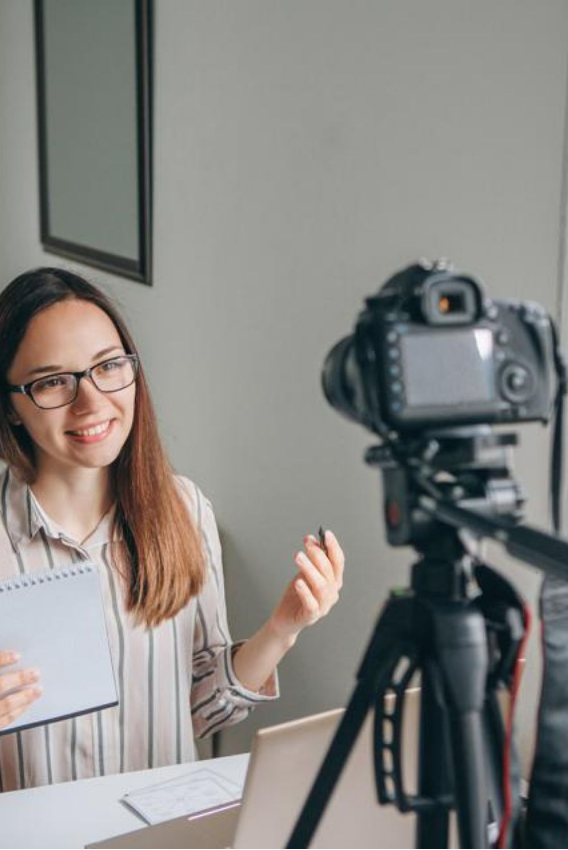
If you’ve ever recorded ten seconds of a video, watched it back, and immediately deleted it — you’re not bad on camera. You’re just doing something you were never trained to do.
Coaches and therapists spend years learning how to listen, hold space, and respond to another person in real time. The camera asks you to do the opposite: talk to someone who isn’t there, with no reaction, no nod, no “mm-hmm” telling you you’re on the right track. That silence is what feels unnatural — not you.
Here’s how to fix it.
1. Stop thinking of it as a camera. Think of it as one person.
The awkwardness usually starts with what you’re picturing while you record — a lens, an audience, a performance. Instead, picture one actual client. Someone specific. The one who always asks the question you’re about to answer in this video.
Talking to someone is a skill you already have. Talking at a device is the skill that feels foreign. Borrow the one you’re already good at.
2. Record before you feel ready
Waiting to “feel ready” is usually the thing keeping people from ever starting. The natural, comfortable version of you on camera doesn’t show up before you press record — it shows up because you pressed record enough times.
Give yourself permission to post something that isn’t your best. The tenth video is always more comfortable than the first. You can’t get to video ten without posting videos one through nine.
3. Use a real client question as your script
Instead of writing a script from scratch, pull an actual question a client has asked you — in a session, a DM, an intake call. Answer it exactly the way you would if they were sitting across from you.
This does two things: it gives you a natural starting point instead of a blank page, and it keeps your tone conversational instead of performative, because you’re not writing content — you’re answering a person.
4. Do more takes, not better takes
Most people re-record the same 10 seconds trying to get it “right.” That’s backwards. The fix isn’t perfecting one take — it’s doing several takes back to back, without stopping to judge each one, and picking the one that feels most like you afterward.
The moment you stop critiquing mid-recording, your energy changes. You’re less stiff by take three, not because you memorized it better, but because you stopped performing and started just talking.
5. Don’t watch yourself while you’re talking
If you’re recording on your phone, your own face is right there staring back at you the whole time — which means part of your brain is watching yourself instead of focusing on what you’re saying. Cover your own preview if you can, or tape a small sticky note over it. You’ll sound more like yourself the moment you stop watching yourself say it.
6. Let the imperfect parts stay in
A stumble, a pause, a laugh at yourself — these are usually the parts people connect with most, not the parts that need to be cut. Polished and rehearsed reads as distant. A small imperfection reads as real, and real is what makes someone trust you before they’ve even met you.
You don’t need to be a performer on camera. You need to sound like the person your clients already trust in the room — just in front of a lens instead of across a desk.
You don’t have to figure this out by trial and error
Getting comfortable on camera is one piece. Turning that comfort into content that actually brings in clients — the right hook, the right message, the right offer behind it — is a different skill entirely, and it’s the piece most coaches and therapists never get consistent help with.
That’s what The Predictable Client System takes off your plate. We handle everything — from the messaging behind what you say on camera, to the content system, to the funnel that turns viewers into booked clients — so camera time is the only part you have to show up for.
Book a free 15-minute call and we’ll show you exactly what this would look like for you.